Calcific tendinitis of the shoulder is commonly diagnosed after a scan shows calcium within the rotator cuff. For many patients, that scan result becomes the explanation for their pain. But this is where things often go wrong.
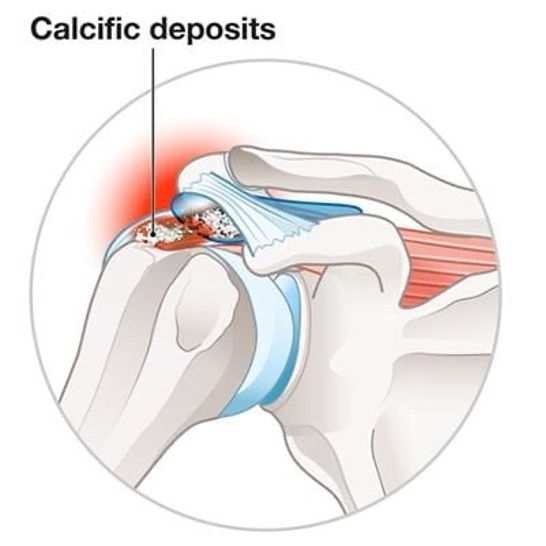
Calcific tendinitis is a clinical diagnosis supported by imaging, not an imaging diagnosis on its own. The presence of calcification does not automatically mean it is the cause of symptoms.
Understanding this distinction is key to choosing the right treatment and avoiding unnecessary or ineffective interventions.
Calcifications within the rotator cuff are common and can be found in people with no shoulder pain at all. They may be longstanding, inactive, or completely incidental.
This means:
- Just because a scan shows a calcification does not mean the person has calcific tendinitis
- Imaging findings must match the clinical presentation
- The location, behaviour, and symptom pattern matter more than the scan label
A scan should support the diagnosis, not replace it.
When shoulder pain is present, the calcification may still not be the problem
Even when someone has shoulder pain and a rotator cuff calcification, the pain generator may be something else.
A very common scenario is:
- Shoulder pain consistent with subacromial or rotator cuff related pain
- A calcification seen on X-ray or ultrasound
- The true source of pain being an inflamed subacromial bursa rather than the calcification itself
In these cases, treating the calcification directly misses the real driver of symptoms and can place the patient in unnecessary risk.
Why the first intervention is usually the subacromial bursa
When physiotherapy, time, and rehabilitation alone are not enough, my first interventional step is typically a subacromial bursa steroid injection.
The reason is simple:
- Subacromial bursitis commonly coexists with rotator cuff pathology
- Settling the bursa often settles the pain
- A significant proportion of patients improve without needing further procedures
This approach is targeted, lower risk, and avoids unnecessary escalation when the calcification is not the active problem.
When barbotage becomes relevant
If symptoms persist despite appropriate rehabilitation and a well targeted subacromial bursa injection, then true calcific tendinopathy needs to be reconsidered.
At that point, ultrasound guided barbotage may be an option, but only in selected cases.
Suitability depends on several factors:
- Size of the calcification
- Consistency of the calcification
- Whether it is soft or toothpaste like versus hard and solid
- Accessibility and relationship to surrounding structures
If the calcification is dense and solid, barbotage will not be possible or effective.
This decision cannot be made from a report alone. It requires direct ultrasound assessment and correlation with symptoms.
What if barbotage does not work or is not suitable?
If symptoms remain limiting and interventional options are exhausted or inappropriate, then orthopaedic involvement can be considered.
This is usually reserved for:
- Persistent symptoms despite appropriate conservative and interventional care
- Clear correlation between symptoms and calcific disease
- Cases where surgical removal may be appropriate after careful discussion
Importantly, surgery is not a first line treatment for most patients with calcific shoulder pain.
Bottom line
Calcific tendinitis is not diagnosed by a scan alone. Calcifications are common, often incidental, and frequently not the cause of pain.
The scan must match the story, the examination, and the symptoms.
Treat the shoulder, not the image. Start with rehabilitation. Address the subacromial bursa when appropriate. Reserve barbotage for carefully selected cases. Escalate to orthopaedics only when the diagnosis and pathway truly justify it.
This stepwise approach avoids overtreatment and gives patients the best chance of meaningful, lasting improvement.