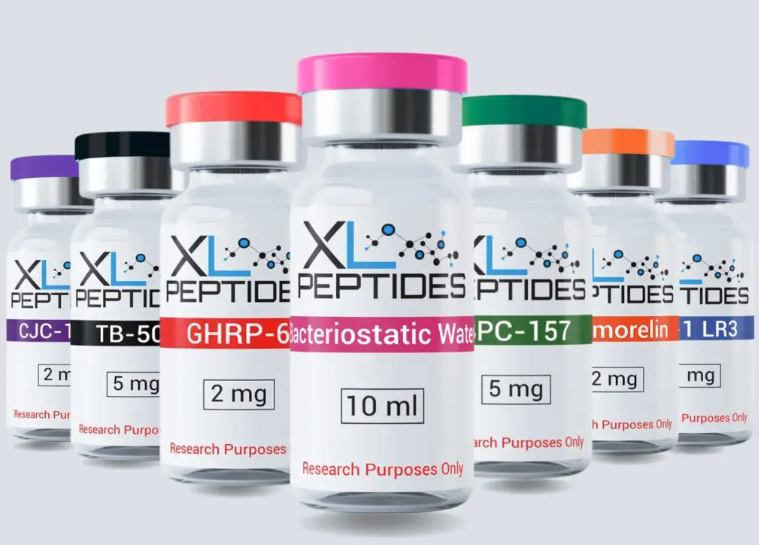
Peptides are everywhere right now. Especially in fitness and bodybuilding circles.
They are often talked about as a shortcut to healing. Faster recovery. Stronger tendons. Less pain. Better performance.
The reality is more complicated.
This article breaks down what peptides actually are, what the science really shows, and what you need to think about before going anywhere near an injection.
What are peptides?
Peptides are short chains of amino acids. These are the building blocks of proteins.
In the body, many peptides act as signalling molecules. They tell cells when to switch things on or off. That is why they are being explored for roles in healing, inflammation, and tissue repair.
It is important to understand that peptides are not new.
Some are already well established in medicine. For example, Insulin is a peptide that has been used safely for decades in diabetes. More recently, drugs like Mounjaro are also peptide based and are now widely used in metabolic medicine.

So the concept itself is not experimental.
The issue is that the peptides being promoted for injury recovery are very different from those approved and used in clinical practice.
Why have peptides become popular for recovery?
The messaging is simple and very appealing.
Tendon healing is slow so peptides must speed it up
Inflammation is harmful so peptides must reduce it
Muscles recover faster so you can train harder

It sounds convincing.
But a good story is not the same as good evidence.
What does the science actually say?
Most of the excitement comes from three places:
Animal studies
Laboratory studies on cells
Anecdotal reports
These all have limitations.
Animal studies do not reliably translate to humans.
Cells in a dish do not behave like a real injury in a real person.
Anecdotes are not controlled and are heavily influenced by expectation.
For commonly discussed compounds such as BPC 157 and TB 500, high quality human research is lacking.
We do not have clear answers on:
Effective dosing
Meaningful clinical outcomes
Short and long term safety
Consistency of results across different populations
This does not prove they do not work.
But it does mean we cannot say with confidence that they do.
The issues people often overlook
1. Safety and purity
One of the biggest concerns is what is actually in the vial.
Many peptides are bought online from unregulated sources. There is no guarantee of purity, dose, or even identity. Contamination and inconsistency are real risks.
2. Regulation and legality
Most of these products are not approved for treating injuries.
That matters. Regulation is what ensures quality control, safe dosing, and ongoing monitoring.
Without that framework, you are effectively taking part in an uncontrolled experiment.
3. Doping risk
For athletes, this is a serious consideration.
Some peptides are on prohibited lists. Even if they are not, contamination can still lead to a positive test.

4. The risk of injecting
Injection itself is not risk free.
There is a risk of infection, tissue irritation, and damage to surrounding structures. This risk increases significantly when injections are done outside a clinical setting.
Why I am not prescribing them
As a sports and exercise medicine doctor, my threshold is clear.
- There needs to be solid human evidence of benefit
- The dosing and sourcing need to be reliable
- The safety profile needs to be understood
- There needs to be appropriate regulation
At the moment, most peptides being marketed for injury recovery do not meet that standard.
Bottom line
Peptides are not automatically a scam.
But many of the claims being made are far ahead of the evidence.
If you are dealing with an injury, you are far better off focusing on treatments that are proven, measurable, and safe rather than experimenting with unregulated injections.